
Why do food and beverage plants dose ozone into tanks and recirculation piping, then install UV at the outlet?
Storage and production require different water conditions. A residual of O₃ (ozone) can be maintained in hygienic tanks and recirculation loops to extend microbial control. Before water reaches blending, filling or other product-contact steps, it should be reduced to the process release value. The U.S. Food and Drug Administration (FDA) permits ozone in food treatment, storage and processing but does not require it to remain at the product stage.[1]
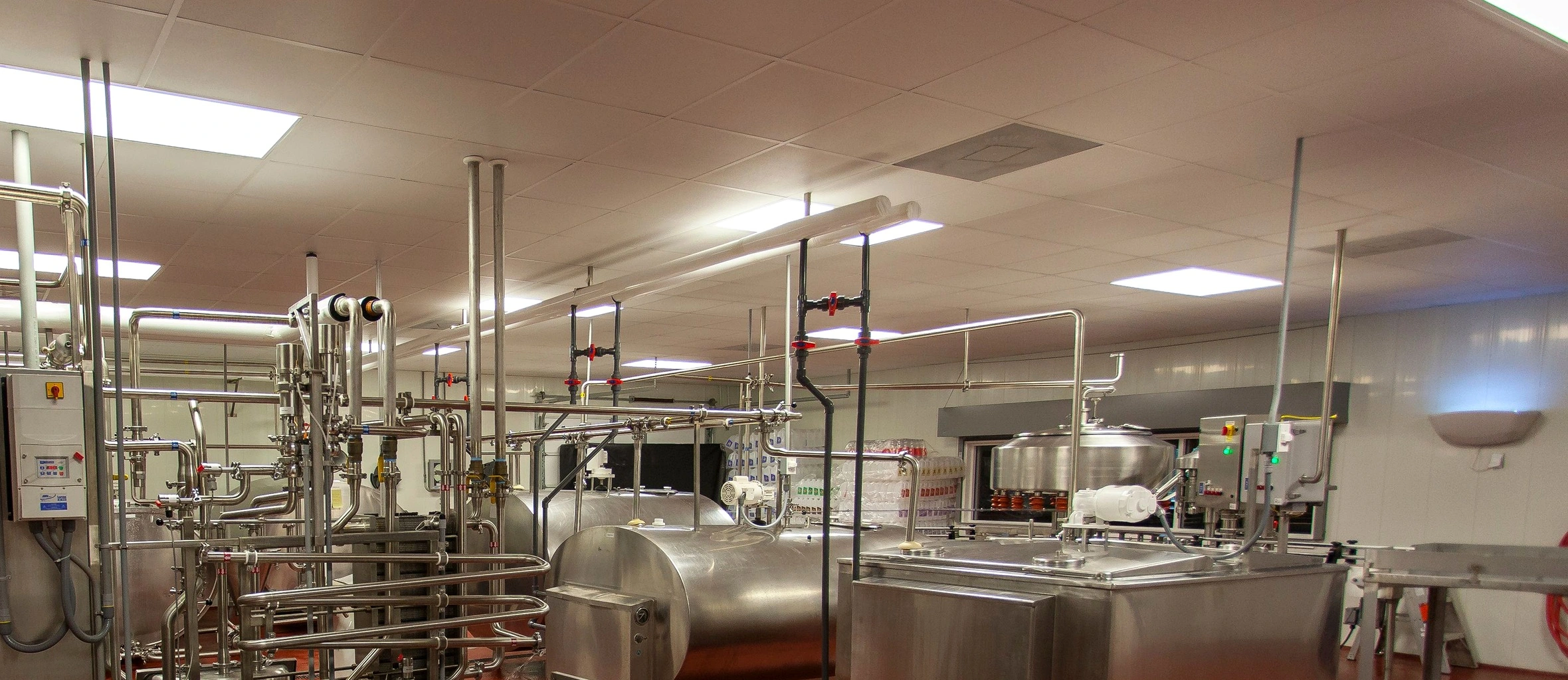
Photo by Mark Stebnicki
Storage control and production release require different ozone levels
Residual ozone continues acting during tank residence and circulation but cannot replace drainage, vent filtration, appropriate turnover or clean-in-place (CIP). At the product stage, it may continue oxidizing flavor compounds, vitamins, lipids, enzymes or fermentation microorganisms and increase oxidative loading on sensitive materials. Effects depend on concentration, contact time, temperature, pH and food matrix; outlet targets must therefore reflect the specific recipe, process and measurement capability.[2]
UV creates a process transition point
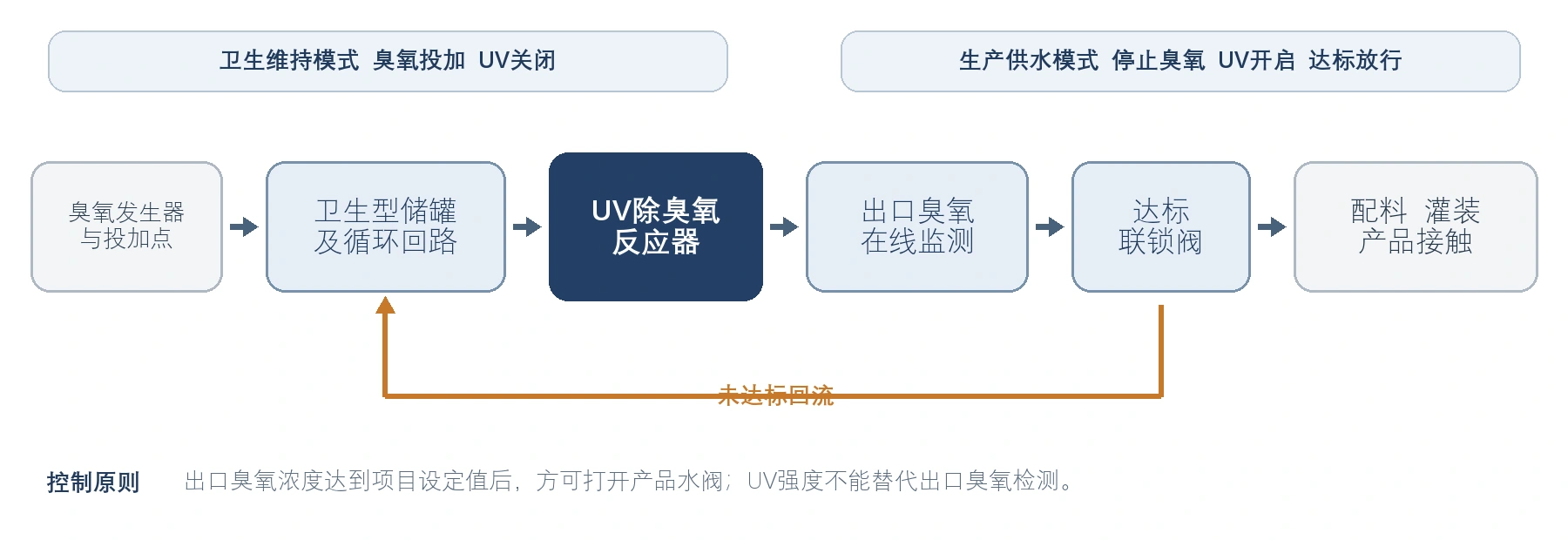
Place UV downstream of ozonated tanks or recirculation loops and upstream of product-contact steps. For intermittent operation, ozone can be switched off and UV recirculation started, releasing water only after outlet ozone stabilizes at the setpoint. For continuous operation, verify single-pass capacity at maximum inlet ozone and maximum flow.
Ozone removal requires both UV dose and outlet concentration
Ozone absorbs UV energy and undergoes photolysis, potentially forming intermediates such as hydrogen peroxide and hydroxyl radicals. Reaction rate depends on intensity, inlet ozone, pH, inorganic carbon and water matrix.[3]
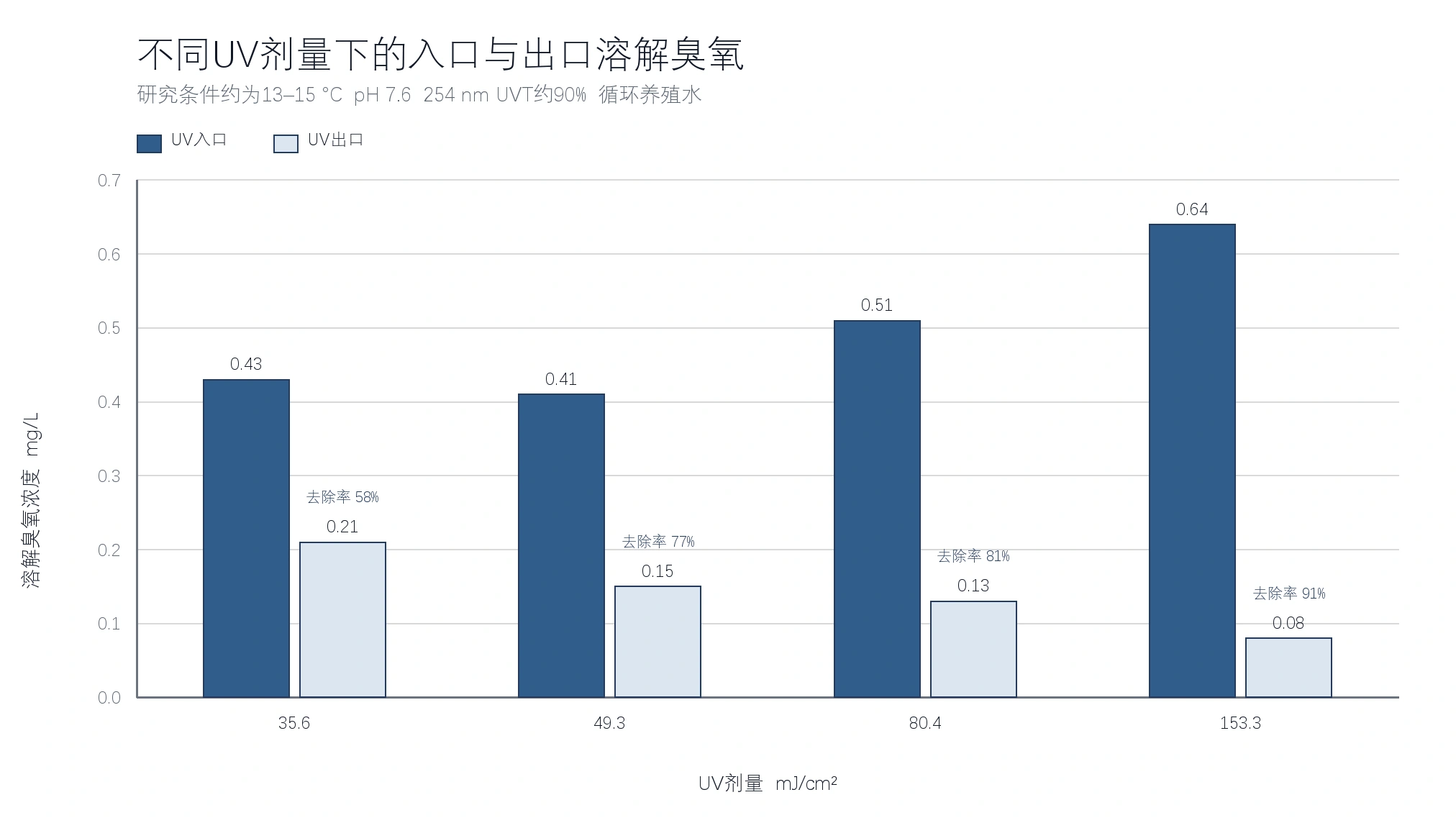
In full-scale flow-through experiments, increasing UV dose from 35.6 to 153.3 mJ/cm² increased mean removal from approximately 58% to 91%, but inlet ozone differed among groups.[4] Interpret dose together with flow, inlet ozone and minimum UV transmittance (UVT), and include water temperature, end of lamp life and sleeve fouling in selection.
UV intensity indicates lamp and optical condition; it does not replace outlet dissolved ozone measurement. Acceptance records should include inlet/outlet concentrations, analytical method and limit of detection (LOD) or quantification (LOQ); below detection is not absolute zero. Because ozone readily decays and escapes, sampling position, response time and calibration method must be fixed. USEPA likewise emphasizes dedicated measurement and prompt sampling.[5]
Compare LP and MP under the same operating conditions
Low-pressure (LP) and medium-pressure (MP) UV lamps cannot be categorized by flow alone. Near-monochromatic LP emission at 254 nm generally favors electrical-to-optical efficiency and lamp life in clean, high-UVT water. MP has higher power density and may offer compactness at high loading, high flow or restricted space. Compare performance and energy use at the same inlet ozone, outlet target, minimum UVT, maximum flow and end of lamp life (EOLL).
How WORU addresses these requirements
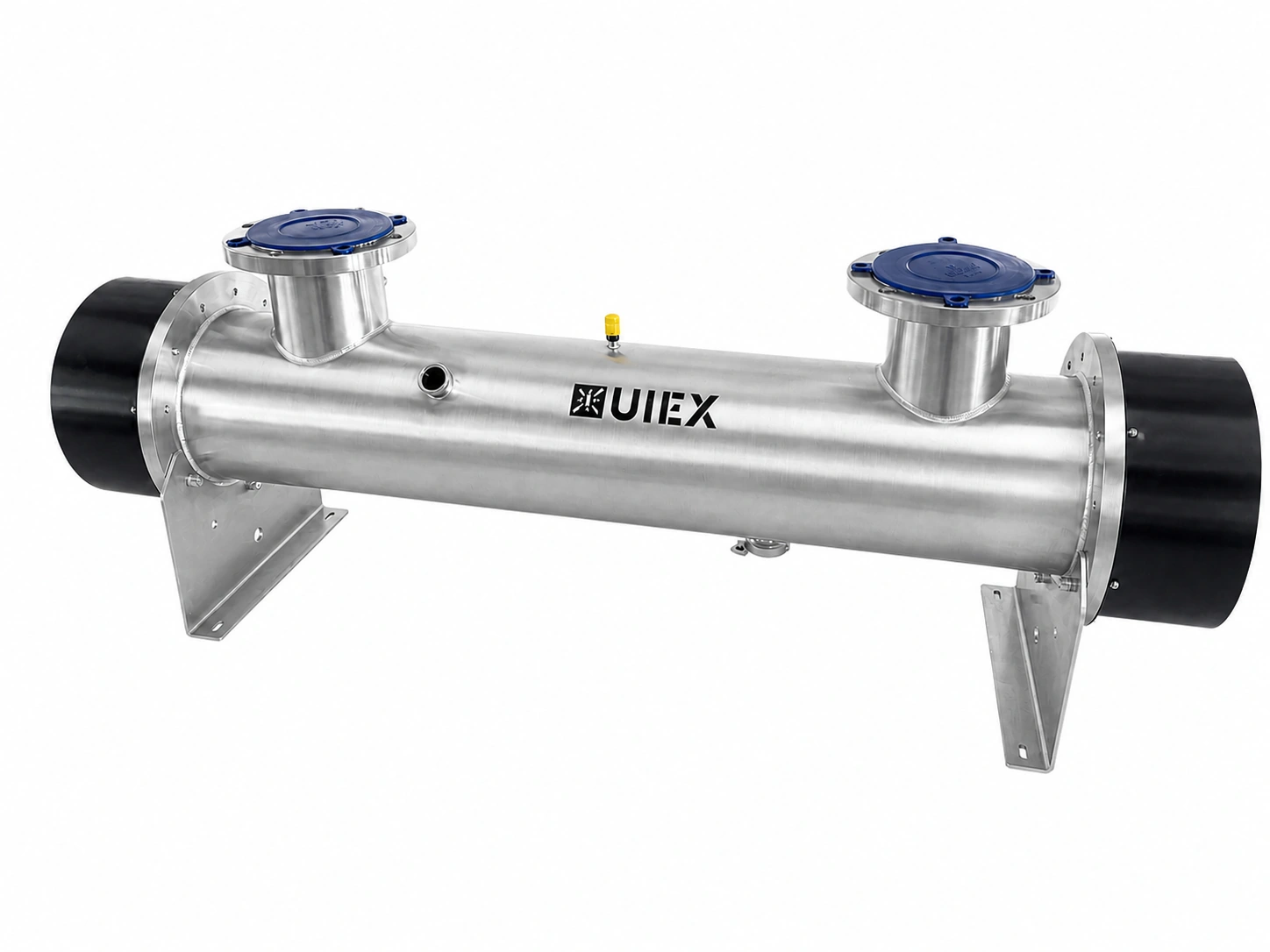
Select for actual loading: WORU selection uses minimum UVT, maximum design flow, UV inlet ozone, target outlet limit and EOLL output, not pipe diameter or installed power alone.
Establish production release interlocks: outlet dissolved ozone, UV status and valve logic form a control point. Water is released to blending, filling or other product processes only while ozone continuously meets the setpoint.
Choose LP or MP for the conditions: at high UVT and stable loading, first compare LP efficiency and lamp life. For higher flow, higher inlet ozone or limited space, compare MP power density and compactness. Decide from outlet curves, energy and maintenance requirements at the same design point.
Match output to loading: if the control system accepts flow, UVT, UV intensity and outlet ozone signals, it can modulate power using a confirmed algorithm, meeting the outlet target while reducing unnecessary full-power operation.
Support long-term hygiene and maintenance: low-roughness 316L flow paths, hygienic connections, drainable construction, CIP-compatible seals, single-ended maintenance and online mechanical cleaning support clean operation. Lamp hours, alarms and maintenance events can be integrated into factory automation.
End ozone treatment at the correct point
UV cannot remove bromate or other oxidation products already formed during ozonation, nor replace tank, circulation and CIP management. Define where ozone should act and where its action must end, using outlet concentration, operating records and interlocks to demonstrate release conditions.
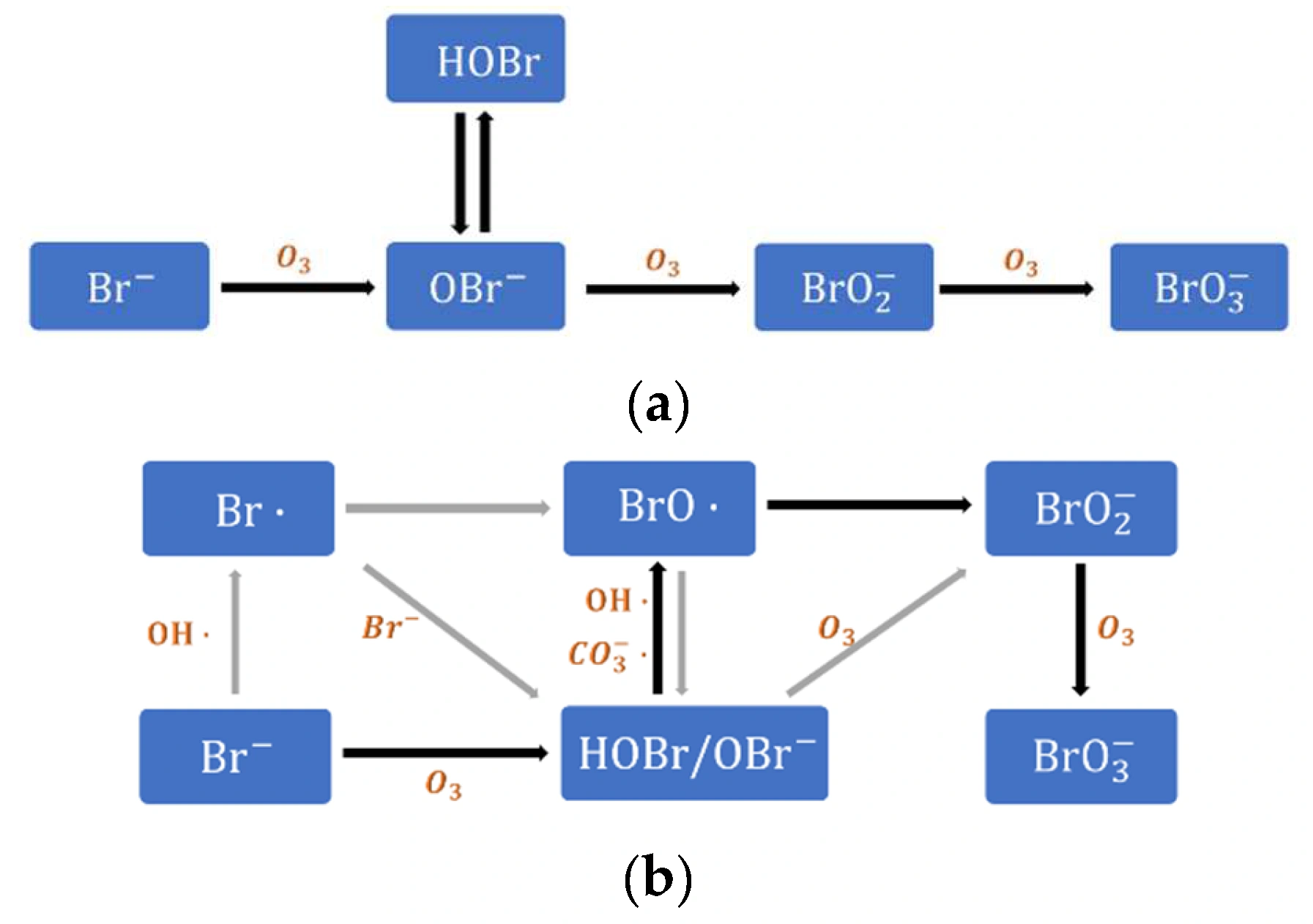
Source: Lu, H., Li, Q., & Feng, W. (2022), Fig. 4. Sustainability, 14(3), 1556. CC BY 4.0. https://doi.org/10.3390/su14031556. Original figure; format converted only.
References
【1】Ozone, 21 C.F.R. § 173.368 (2026).
【2】U.S. Environmental Protection Agency. (1999). Alternative disinfectants and oxidants guidance manual (EPA 815-R-99-014). Office of Water.
【3】Gurol, M. D., & Akata, A. (1996). Kinetics of ozone photolysis in aqueous solution. AIChE Journal, 42(11), 3283–3292.
【4】Summerfelt, S. T., Sharrer, M. J., Hollis, J., Gleason, L. E., & Summerfelt, S. R. (2004). Dissolved ozone destruction using ultraviolet irradiation in a recirculating salmonid culture system. Aquacultural Engineering, 32(1), 209–223.
【5】von Gunten, U. (2003a). Ozonation of drinking water: Part I. Oxidation kinetics and product formation. Water Research, 37(7), 1443–1467.
【6】Premjit, Y., Sruthi, N. U., Pandiselvam, R., & Kothakota, A. (2022). Aqueous ozone: Chemistry, physiochemical properties, microbial inactivation, factors influencing antimicrobial effectiveness, and application in food. Comprehensive Reviews in Food Science and Food Safety, 21(2), 1054–1085.
【7】Lu, H., Li, Q., & Feng, W. (2022). Application progress of O₃/UV advanced oxidation technology in the treatment of organic pollutants in water. Sustainability, 14(3), 1556.