
Assessing high-flow food and beverage inlet water and the WDU-MP approach
Water enters the risk chain before it enters the recipe
Inlet water in food and beverage plants may become an ingredient or be used for rinsing, clean-in-place (CIP) and process water. Compliance at the municipal waterworks does not rule out recontamination through city mains, plant tanks and points of use. Lake water varies with seasons, algae, organic matter and suspended particles. The key is not simply to add another disinfection unit, but to establish a verifiable microbial barrier at the production boundary.
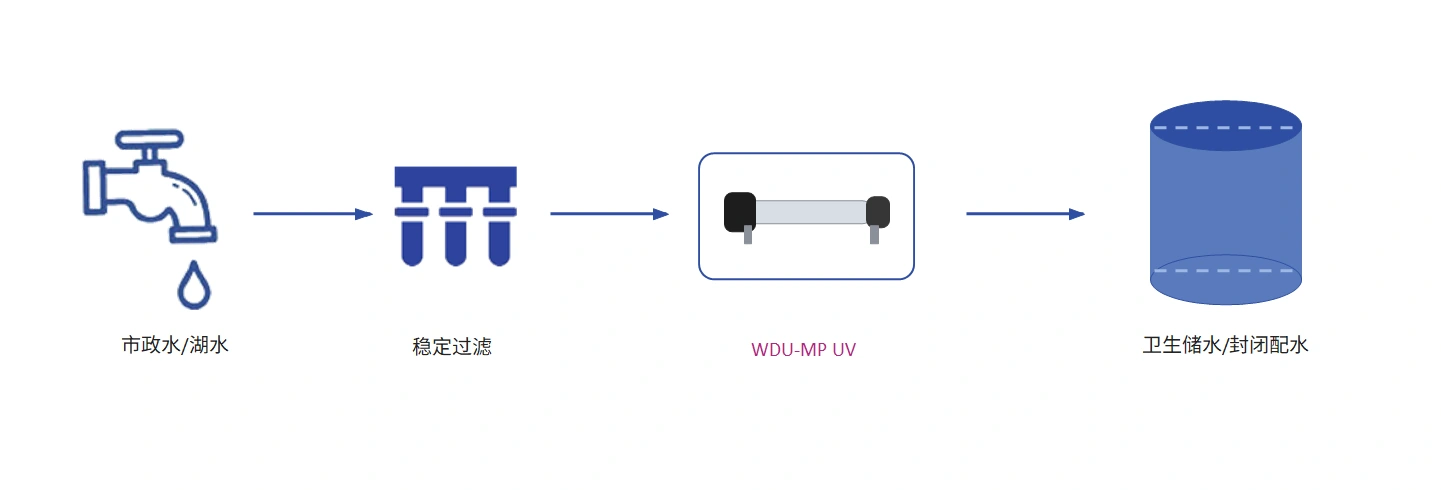
UV should preferably follow filtration that stabilizes particles, turbidity and UVT254 (UV transmittance at 254 nm over a 1 cm path), as close as possible to the hygienic storage or production supply boundary. Filtration reduces particle shielding and quartz sleeve fouling; UV inactivates microorganisms; closed piping and hygienic tanks prevent recontamination. These are sequential barriers, not substitutes.[1,4]
When lake water is used, retain an important engineering limit: if simple filtration cannot stabilize minimum UVT and particle loading during heavy rain, algal seasons or low water levels, strengthen pretreatment to address water quality uncertainty.
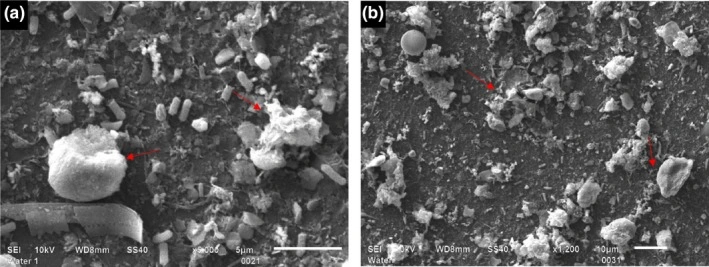
Caption | Shielding of UV irradiation by suspended particles。In the scanning electron micrograph, E. coli indicated by red arrows may attach to or hide around suspended particles. Shielding can reduce the UV dose actually received by microorganisms. Stable control of turbidity and particle loading before UV disinfection is therefore important for effective dose delivery.
Why consider medium-pressure UV for high flow and high dose?
The scientific advantage of medium-pressure UV is not only higher power per lamp, but multiwavelength emission across approximately 200–300 nm in the germicidal range. Nucleic acids and proteins absorb wavelengths differently, so multiple wavelengths may act on both microbial genomes and key proteins rather than relying entirely on a single 254 nm inactivation pathway.[3,5]
This matters particularly for viruses such as adenovirus that are relatively resistant to 254 nm UV. Under their test conditions, Linden et al. (2007) found significantly greater adenovirus inactivation with full-spectrum medium-pressure UV than with monochromatic 254 nm low-pressure UV, with a particularly strong contribution below 240 nm. Eischeid and Linden (2011) further observed greater adenovirus protein damage with medium-pressure UV at higher doses. This supports the mechanism that multiple wavelengths can add inactivation pathways.[2,3,5]
A variable raw water study is particularly relevant to food and beverage inlet water. Adhikari et al. (2020) treated pond water, well water and mixtures with 3.4 kW medium-pressure UV at turbidities of 10.93–23.32 NTU. Significant E. coli reductions were observed at 20–60 mJ/cm²; lowering turbidity from 23.32 NTU to 10.93 NTU improved the reduction by approximately 2.15 log MPN/100 mL.[4] This supports medium-pressure UV as a raw water microbial barrier, provided upstream filtration first controls shielding and optical attenuation within the design range.
For high-flow projects, lamp power and reactor design provide only the underlying equipment capacity. The key scientific question is whether multiwavelength output becomes a validated delivered dose. For medium-pressure reactors, USEPA specifically requires consideration of differences in action spectra between target pathogens and challenge organisms, with validation bounded by maximum flow, minimum UVT, lamp aging, sleeve fouling and reactor hydraulics.[1,6] Medium-pressure UV therefore offers greater design latitude for high-flow or high-dose needs, but final performance must be demonstrated by biodosimetric validation.
Check delivered dose under the least favorable conditions: peak flow, minimum UVT, reactor hydraulics, lamp aging, sleeve fouling and target microorganisms must all be included.
How WDU-MP addresses these requirements
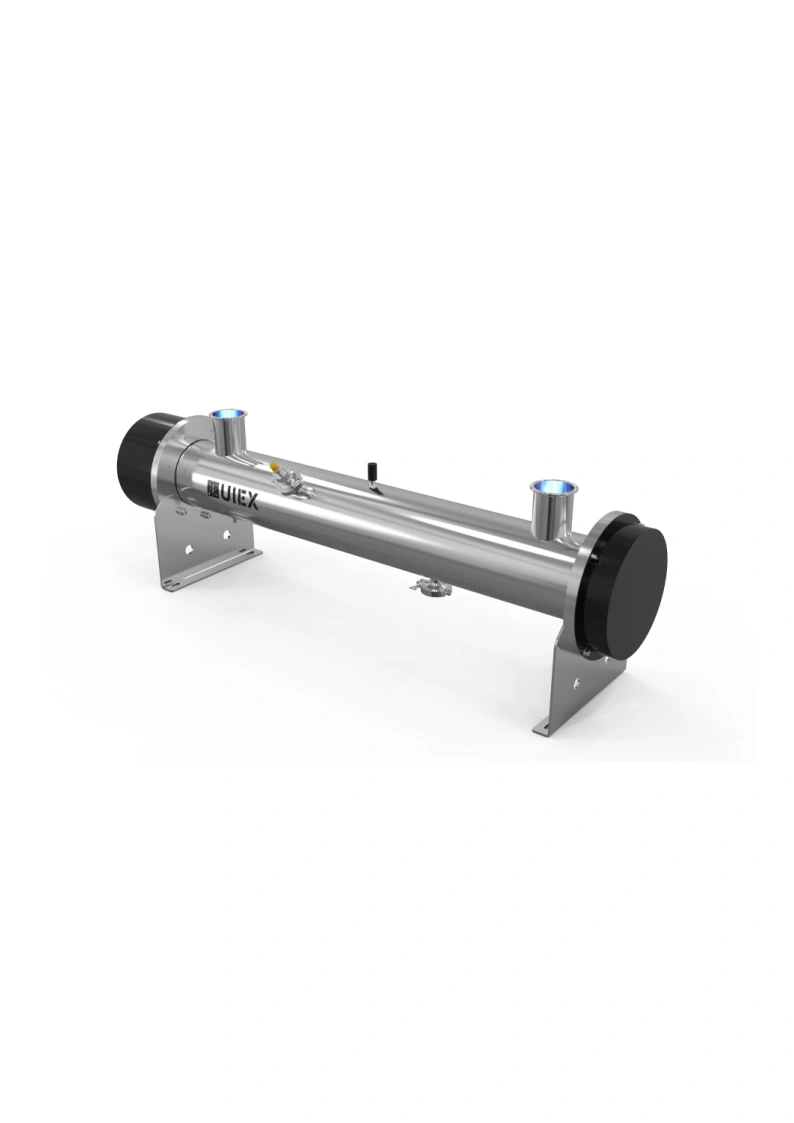
- High-power individual medium-pressure lamps provide high capacity with fewer lamps and a smaller footprint, reducing seals, ballasts and maintenance points.
- The system accepts real-time flow and UVT signals, continuously modulates lamp power and maintains target dose through end of lamp life. Low-dose alarms, operating trends and maintenance events can be integrated into SCADA.
- CFD-optimized reactor hydraulics produces a more uniform dose distribution while controlling pressure drop and pumping demand at high flow.
- Food-contact seals, drainable construction, verifiable CIP temperatures and material documentation together support auditable hygienic design.
Start selection with water samples and the operating variation range
For formal selection, obtain peak flow, minimum UVT, turbidity and color, target microorganisms and log reduction value (LRV), target dose, water temperature, pressure, allowable pressure drop and sleeve scaling risk. Then verify flow–UVT–dose curves at end of lamp life. Model designation, power and pipe diameter do not establish microbial inactivation performance.
UV also has limits: it does not change the chemical composition of the water and leaves no persistent residual effect. Correct placement, online dose verification, hygienic storage and closed downstream transfer are needed to make it an effective quality barrier for food and beverage ingredient water.
References
[1] U.S. Environmental Protection Agency. (2006). Ultraviolet disinfection guidance manual for the final long term 2 enhanced surface water treatment rule (EPA 815-R-06-007).
[2] Hijnen, W. A. M., Beerendonk, E. F., & Medema, G. J. (2006). Inactivation credit of UV radiation for viruses, bacteria and protozoan (oo)cysts in water: A review. Water Research, 40(1), 3–22. https://doi.org/10.1016/j.watres.2005.10.030
[3] Linden, K. G., Thurston, J., Schaefer, R., & Malley, J. P., Jr. (2007). Enhanced UV inactivation of adenoviruses under polychromatic UV lamps. Applied and Environmental Microbiology, 73(23), 7571–7574. https://doi.org/10.1128/AEM.01587-07
[4] Adhikari, A., Parraga Estrada, K. J., Chhetri, V. S., Janes, M., Fontenot, K., & Beaulieu, J. C. (2020). Evaluation of ultraviolet (UV-C) light treatment for microbial inactivation in agricultural waters with different levels of turbidity. Food Science & Nutrition, 8(2), 1237–1243. https://doi.org/10.1002/fsn3.1412
[5] Eischeid, A. C., & Linden, K. G. (2011). Molecular indications of protein damage in adenoviruses after UV disinfection. Applied and Environmental Microbiology, 77(3), 1145–1147. https://doi.org/10.1128/AEM.00403-10
[6] U.S. Environmental Protection Agency. (2022). The Ultraviolet (UV) Treatment Toolkit: Technical Resource for States Using EPA’s Ultraviolet Disinfection Guidance Manual to Evaluate UV Technology (EPA 815-B-21-007). https://www.epa.gov/system/files/documents/2022-05/uv-toolkit-815-B-21-007_0.pdf